Three…two…one…we have ignition!
Have you ever closed your eyes on a rollercoaster out of fear? Or perhaps just to add to the thrill factor? If your answer is yes, then you’re in luck. Eyes are optional on Disney’s Space Mountain!
This groundbreaking rollercoaster may blast off into the dark of space, the story of Space Mountain began on the slopes of Disneyland’s Matterhorn Mountain, and wound its way across the country to the swamplands of Florida. Along the way, Walt Disney and his Imagineers experienced a ride as twisty and mysterious as the coaster itself.
Come take a trip through the stars with me, as we celebrate the history and impact (and some trivia) of Disney’s Space Mountain.
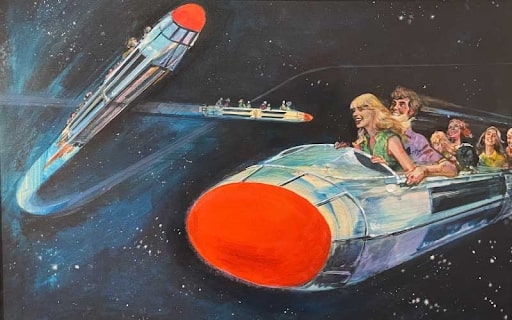
Walt Disney – Ahead of His Time
Space Mountain may have opened as an attraction in 1975, but the story Space Mountain began over 15 years earlier in Disneyland’s Tomorrowland. Matterhorn Bobsleds – the very first Disney “mountain” – opened in 1959 as part of Disneyland’s Tomorrowland expansion that also saw the debuts of the Monorail and Submarine Voyage. As the first thrill ride in Disneyland, Matterhorn Bobsleds was hugely popular with guests, and the rollercoaster’s success convinced Walt Disney that thrilling rides did indeed have a place in his park.
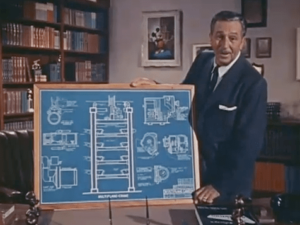
Just a few years after opening the Matterhorn, Walt began to envision a concept for a cosmic-themed rollercoaster – one that would simulate an actual voyage through space! The initial concept for the coaster was to have four separate tracks winding their way inside a fully enclosed dome. Controls for the coasters would be run using computers, which were breaking technology at the time.
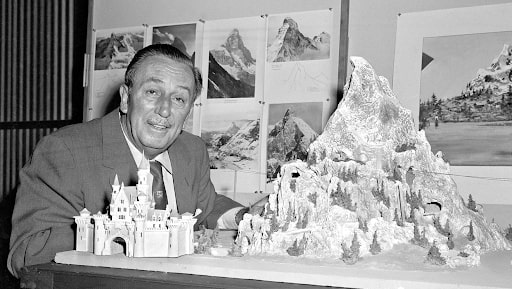
Walt first approached Disney Legend John Hench in 1964 to assist in making his space-age dream a reality. The coaster’s name changed names three times during the conceptual stage, beginning with Space Voyage, then Space Port, and finally settling on Space Mountain in 1966.
Unfortunately, Walt’s visions were a little too far ahead of his time to realize. The modern controls needed to safely operate the coaster were not available, and Disneyland just didn’t have the space within the berm to fit the ride. Walt’s space coaster was tucked away for another day – one that unfortunately did not come until after he passed away.
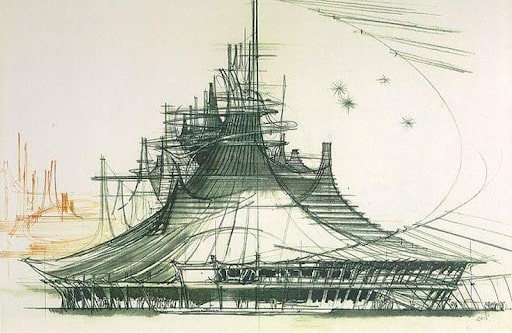
Building a Mountain in Florida
Disneyland may have had some significant space limitations in the 1960s, but real estate was plentiful and cheap in the swamps of Central Florida. Before Walt died, he bought up over 27,000 acres in the Sunshine State to build his “Disney World.”
Thanks to what Walt called the “blessing of size,” the Space Mountain project received new life in 1969, when the attraction was earmarked for a home in the future Magic Kingdom. In addition to larger space, technology had caught up to Disney’s Imagineers, who now had the computing power to manage the complex operation of the coaster.
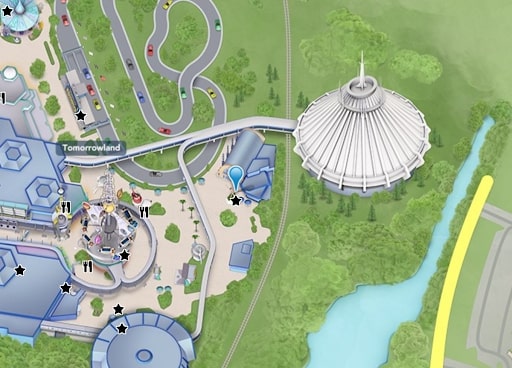
Despite Magic Kingdom’s additional size, Imagineers decided that four coaster tracks within Space Mountain would make the overall structure too large to reside cohesively in the park. They scaled the ride back to two tracks to decrease the building’s footprint, and moved the structure outside the Walt Disney World Railroad berm surrounding the park, leaving only a smaller entrance building within the berm. This strategy had been used several times before in Disneyland, most notably for “it’s a small world”, Pirates of the Caribbean, and Haunted Mansion – all of which reside outside the famous Disneyland Railroad berm.
To help cover the costs of developing and building Space Mountain, Card Walker – CEO of Walt Disney Productions – convinced RCA chairman Robert Sarnoff to sponsor the new attraction. RCA had been awarded a contract to provide the communications hardware for the development of Walt Disney World Resort. The contract also stated that if Disney presented an attraction of interest, RCA would provide $10 million to support it. Disney and RCA struck a deal, and RCA sponsored the attraction from its opening in 1975 until 1993.
Space Mountain opened alongside Walt Disney’s Carousel of Progress on January 15, 1975 – over three years after the park first opened to guests on October 1, 1971. The celebration was one for the (space) ages, featuring a 2,000-member marching band, balloons, fireworks, and even NASA astronauts Gordon Cooper, James Irwin, and Scott Carpenter.
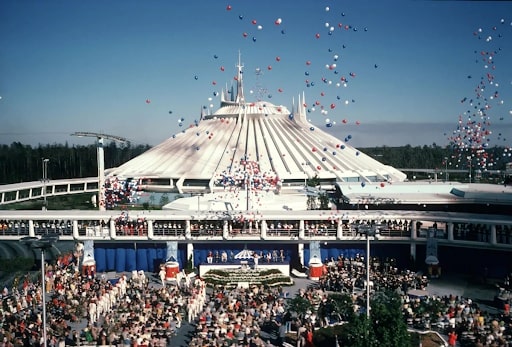
Cooper – commander of Mercury 9 and Gemini 5 – became a member of the Disney team and provided personal consultation to help ensure the authenticity of the attraction. The astronaut saw Space Mountain as “an attempt to give people the most realistic feeling of what they might encounter in space without actually taking a real space flight.” Citing Cooper’s contribution, Disney proudly proclaimed that the attraction took full advantage of knowledge gained during the manned and unmanned space probes conducted by NASA.
According to Disney publicity from the opening year of 1975, “Space Mountain captures the essence of Superspace. The expectant ‘space voyager’ is transported through the space station launch portal, and through the vast man-made ‘solar field.’ He then orbits the glowing ‘satellite,’ becomes engulfed in spectacular nebulae and plunges past myriads of strange stars and unknown galaxies to begin re-entry.”
Designing a Park Icon
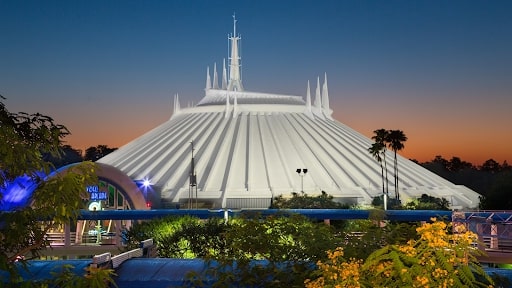
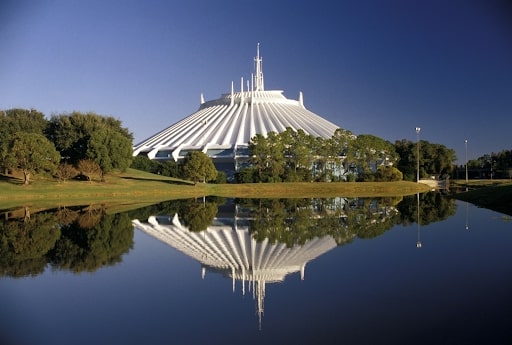
What would Magic Kingdom’s Tomorrowland skyline look like without the distinctive shape of Space Mountain? I can’t imagine it any other way! It was John Hench who designed the “iconically conical” shape of Space Mountain. The stark white “spaceport” uses seventy-two 74-ton beams that reach 117 feet into the sky above Tomorrowland. The overall structure stands 183 feet tall and 300 feet in diameter.
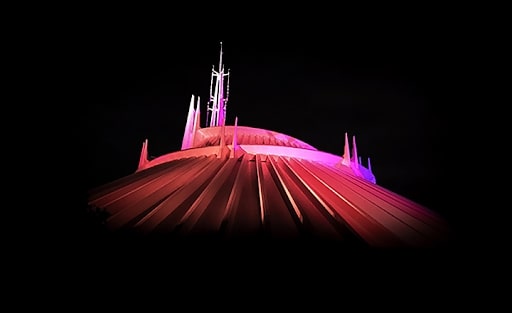
Inside the structure, the coaster moves on two separate ride tracks – Alpha and Omega. The tracks are nearly identical to each other, save for an additional ten feet of overall length for the Alpha track. According to Steven Vagnini of the Walt Disney Archives, Space Mountain was the first coaster experience to be fully enclosed and in the dark.
In addition to being the first indoor dark rollercoaster, Space Mountain was also the first rollercoaster to be fully controlled by a computer. At first launch in 1975, Space Mountain was controlled by a pair of Nova 2/10 computers, which were able to respond instantaneously to any unexpected event by immediately halting all mechanical movement. Nowadays, this type of computer control system is commonplace, but in 1975 it was highly innovative and emphasized Disney’s commitment to guest safety. Per Vagnini, “This allowed us to have two totally separate ride paths through space. The zone systems allowed multiple rockets to allow guests to be transported through the cosmos at once.”
Fun Fact: In addition to bringing several “firsts” to the theme park world, Space Mountain is also the oldest operating roller coaster in Florida.
Inside Magic Kingdom’s Space Mountain
Space Mountain is one of the most photo-friendly Disney structures of all time (perhaps second only to the famous Disney castles). By day, the spaceport strikes a bright white contrast against the blue Florida sky. At night, it gleams above the colorful glow of Tomorrowland. Now, let’s take a look inside the mountain.
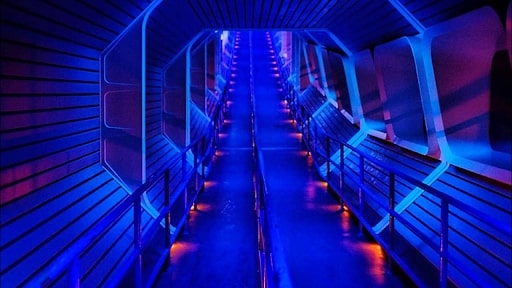
The entrance to Space Mountain in Magic Kingdom sits sort of kitty-cornered in Tomorrowland, to the right of Tomorrowland Speedway. The stylistic Space Mountain sign beckons guests inside. Upon entering the building, guests are not yet inside the mountain; they are entering the “star tunnel.” This tunnel gives guests the illusion that they are walking through outer space, when in reality they are walking down a gradual slope, travelling below the Walt Disney World Railroad, and gradually back up to the actual Space Mountain attraction. It’s one of those seamless Disney transitions that add to the guest experience while also accomplishing the goal of moving guests to the show building.
After boarding their “rockets” (which in the Magic Kingdom version of the attraction are single-rider-style solo seats), guests travel through a “launch” tunnel. This Imagineering trick uses moving lights and sounds to simulate the feeling of launching in a rocket at warp speed, when in actuality guests are simply puttering their way up a chain-operated lift hill.
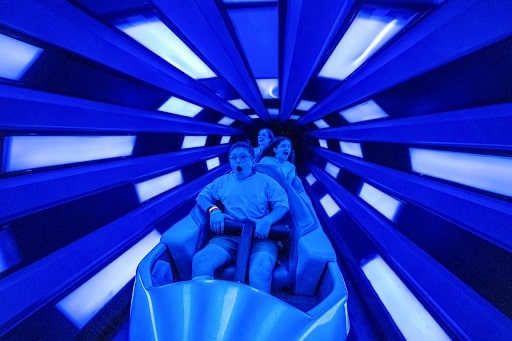
Once fully launched off the lift hill, the remainder of the ride takes place in near-complete darkness, with little more than occasional “star” lights guiding the way. Herein lies the genius of Space Mountain. Traveling in near-complete darkness causes every twist and turn to feel like a gut-wrenching lurch – all while traveling at speeds maxing out at only 28 mph. Fun Fact: With top speeds never reaching 30 mph, Space Mountain doesn’t even crack the top ten list of the fastest rides in Walt Disney World!
Believe it or not, there was not a specific soundtrack music selection playing inside Space Mountain during the ride when it first opened to guests in 1975. Imagineers included a host of space-age sounds to accompany the journey. The first on-ride music was a synth-pop “Starry-O-Phonic Sound” arrangement added in 2010, composed by Mike Brassell (who may be recognized as the voice of the Tomorrowland Transit Authority PeopleMover, as well as EPCOT’s Living With the Land). Brassell’s arrangement can still be heard while traveling through the stars over Magic Kingdom.
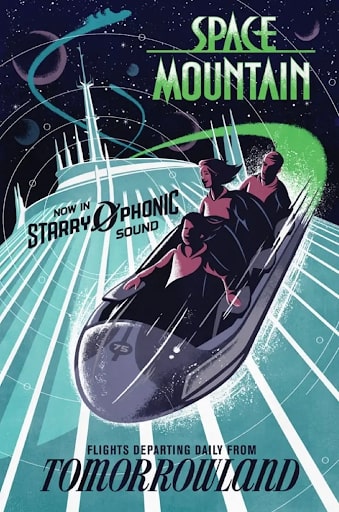
Upon disembarking from the ride in 1975, the post-show for Space Mountain featured new home technology created by its sponsor, RCA. One of the innovations was a laser disc home video system (which, while popular for a period of time, eventually died at the hands of VHS and DVD systems). Guests leaving the attraction could watch a clip of Disney Legend Kurt Russell singing The Archies’ hit song, “Sugar, Sugar” in a clip from The Wonderful World of Disney episode “Disneyland Showtime!” from 1970. But the overarching music in the post-show area was the catchy tune “Here’s to the Future” composed for Disney by Buddy Baker.
A 1985 refurbishment brought with it a much less energetic update to the post-show music, with George Wilkins’ “We’ve Come So Far (Promising Tomorrows)” filling the speakers. Modern-day guests of Magic Kingdom’s Space Mountain will hear a version of Michael Giacchino’s musical score from Disneyland’s 2005 refurbishment (more on that shortly) in the post-show area.
Look a Little Closer
Magic Kingdom’s Space Mountain is stocked with fun Easter Eggs – being the first out of what has become a collection of five spaceports in Disney Parks across the globe.
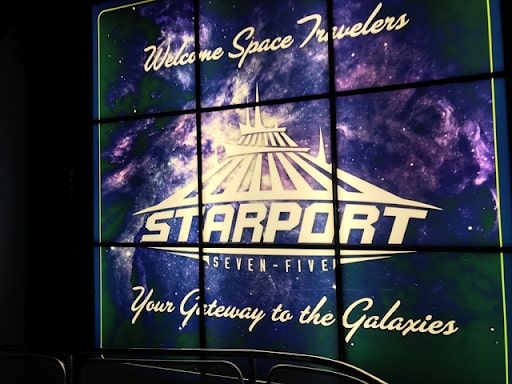
After walking the long star tunnel and arriving at the loading area, guests will notice a large logo reading “Starport Seven-Five,” tucked into a stylistic rendering of the iconic mountain. The logo is referencing 1975 – the year the ride first opened in Walt Disney World.
When you exit the ride, look to the left at the beginning of the exit walkway to see a panel displaying “closed sectors.” These codes refer to several Magic Kingdom attractions that have been retired:
- FL – 20K (Fantasyland – 20,000 Leagues Under the Sea)
- FL – MTWR (Fantasyland – Mr. Toad’s Wild Ride)
- TL – SK2 FL (Tomorrowland – Skyway to Fantasyland)
- MSU – SB (Main Street, U.S.A. – Swan Boats)
- FL -MMR (Fantasyland – Mickey Mouse Revue)
- TL – M2M (Tomorrowland – Mission to Mars)
The best of Space Mountain’s tributes honors Imagineer and chief architect of Space Mountain John Hench. Code H-NCH (SM1975) can be seen on a spaceship in the post-show area.
Before we move on to other Disney Parks, here is one more Fun Fact: Space Mountain was the second attraction ever built specifically for Magic Kingdom which was so popular that it inspired a version for Disneyland. The first attraction was Country Bear Jamboree.
Space Mountain in Disneyland
The smashing success of Magic Kingdom’s Space Mountain prompted Disney to revisit the original plan to build one in Disneyland. Concerns over space limitations remained, but were addressed in classic Disney Imagineer brilliance.
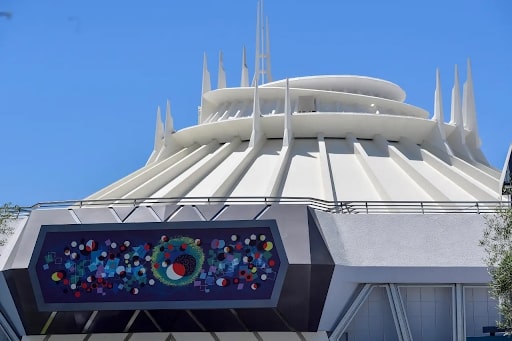
First off – Imagineers incorporated only one track into the design of Disneyland’s Space Mountain, instead of the two tracks included in the Magic Kingdom version. This allowed the attraction’s footprint to be small enough to fit into Tomorrowland’s in-park footprint (in other words, Space Mountain fit inside the berm, whereas Magic Kingdom’s mountain was placed outside the park’s berm). Secondly – and even more brilliantly – the base of the attraction was recessed roughly 15 feet below ground, effectively scaling down the massive building to a height of 76 feet – about a foot shorter than Sleeping Beauty Castle (and almost 50 feet shorter than the Matterhorn)!
After two years of construction, Disneyland’s $20 million Space Mountain complex opened on May 27, 1977, including the roller coaster, a 1,100-seat Space Stage, a 670-seat Space Place (dining) and Starcade.
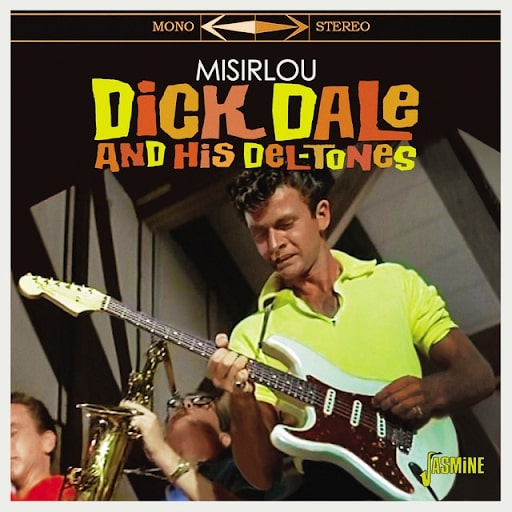
The music of Disneyland’s Space Mountain has a more interesting history than that of the original Florida version. Like Magic Kingdom, the Disneyland attraction opened without specific on-ride music, but that changed iconically in 1995. Composer Aarin Richard worked with surf-rock guitar legend Dick Dale on a two-phase soundtrack to combine a synth-version of the “Aquarium” section of Camille Saint Saens’ “Carnival of the Seas” with echoes of Dale’s classic surf sound. The result is pure storytelling mastery. Ominous undertones slowly build as riders ascend the launch hill, and break into a crescendo when guests “blast off.” The energetic rock tones made the ride through space feel more like surfing through the stars, and it made the coaster feel faster to guests (even though the ride speed didn’t change).
Fun Fact: Disneyland’s 1996 Space Mountain music update, along with the creation of the ride soundtrack for the Disneyland Paris version of Space Mountain (which opened around the same time as Disneyland’s Space Mountain refurbishment), share credit for being the first coasters to add onboard ride music – another Disney Imagineering innovation!
In 2005, in conjunction with Disneyland’s 50th birthday celebration, the Aarin Richard / Dick Dale ride music was replaced with a more orchestral track composed by Michael Giacchino. The theremin-filled, ghostly sounding anthem still plays in the attraction to this day, except during times of thematic overlays.
Disneyland’s Space Mountain Morphology
Disneyland has always been at the forefront of innovation and creative storytelling, and the story of Space Mountain is no exception. Let’s take a look at a few thematic overlays at Space Mountain over the years.
Rockin’ Space Mountain
Rockin’ Space Mountain was a temporary retheme that was presented as part of the “Year of a Million Dreams” celebration at the parks in 2007. The ride experience was themed to a Red Hot Chili Peppers concert in space, playing the band’s cover of Stevie Wonder’s “Higher Ground” complete with LED concert-style lighting.
Fun Fact: The Rockin’ Space Mountain overlay coincided with a Rockin’ California Screamin’ overlay at the adjacent Disney’s California Adventure, which also featured the Red Hot Chili Peppers with a remix of their hit song “Around the World.” These overlays were part of a 2007 “Rockin’ Both Parks” campaign.
Space Mountain: Ghost Galaxy
This seasonal Halloween overlay of Space Mountain began at Hong Kong Disneyland in 2007, and came to Disneyland in 2009. The overlay brought a green “storm” to Space Mountain’s spaceport, causing technological glitches and malfunctions. Guests onboard the coaster see a skeletal nebula creature (nicknamed “Bob” by cast members) who chases them throughout the ride. The overlay returned for several years, but appears to have been discontinued for good, having last been presented in 2018.
Star Wars: Hyperspace Mountain
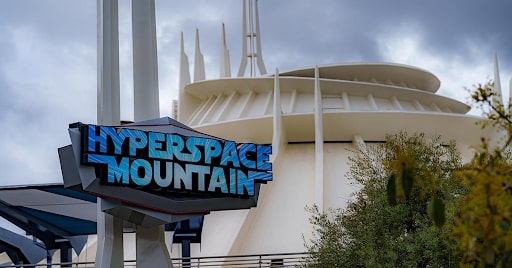
Space Mountain made the jump to lightspeed in 2015 with the first of what has become an annual overlay in a galaxy far, far away. Star Wars: Hyperspace Mountain puts guests in a classic battle between fleets of X-Wings and TIE fighters.
The first Hyperspace Mountain overlay debuted in November 2015 as part of Disneyland’s Season of the Force, celebrating the release of Star Wars: Episode VII – The Force Awakens. Since then, Disneyland’s Season of the Force (and the Hyperspace Mountain overlay) generally occurs in the Spring, with the popular “May the Fourth” day of recognition as the anchor date for the special event.
Tokyo Disneyland
The third version of Space Mountain debuted with the opening of Tokyo Disneyland in 1983. For over 20 years, the Tokyo Disneyland version was an almost exact clone of that in Disneyland. But in 2006 the ride was then redesigned to have a more sci-fi futuristic look more similar to the one in Magic Kingdom. The 2006 refurbishment also included a new spaceport which features a futuristic spaceship hanging from the ceiling.
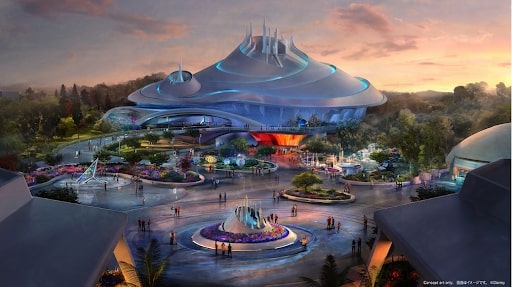
In 2022, Disney Parks Blog announced plans for a thematic reimagining of Tomorrowland, complete with a full refurbishment of Space Mountain. According to Disney Parks Blog, the rebuilt attraction will retain “the original concept as a thrilling indoor coaster that takes guests on a high-speed journey through space but will include enhanced performance and immersive special effects” where “we see our connection to our planet and gain a new perspective for how special it is in all the universe. It’s a roller coaster with both thrill and heart.” In addition to the attraction, Tokyo Disneyland promises “an all-new plaza in Tomorrowland will represent a future where humans are in harmony with nature.”
Disneyland Paris
In 1995, Disneyland Paris opened a different take on Space Mountain in its Discoveryland – a themed land which sees Tomorrowland in a completely fantastical way. Vagnini describes Discoveryland as “not based so much on our current thinking about the future, but rather interpretations and visions of the future that were shared by legendary authors and science fiction writers.”
With this whimsical take on the future in mind, Disneyland Paris opened Space Mountain De la Terre à la Lune (From the Earth to the Moon) in 1995 – three years after the park itself opened. The attraction was inspired by a Jules Verne book of the same name and was designed as a take on space travel from a Jules Verne-era perspective. The coaster track is significantly more modern than those that came before, featuring a cannon-style launch and three inversions (one sidewinder, one corkscrew, and one horseshoe). This version of Space Mountain was also the first to feature onboard audio, synced to the ride experience.
The Parisian Space Mountain was a huge success with guests. After Disneyland Paris had endured a rough opening in 1992 and several years of financial struggle, the success of Space Mountain allowed the park to see its first profits.
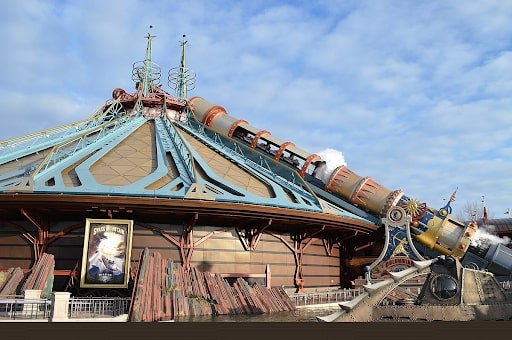
After twenty years of stardom, the attraction was reimagined to become Space Mountain: Mission 2. Space Mountain’s look was modernized both inside and out, with the coaster taking guests beyond the Moon to the edge of the universe.
In 2017, Space Mountain was updated again as part of the 25th anniversary celebration of the park, adopting Disneyland’s Star Wars: Hyperspace Mountain theme. But unlike Disneyland’s retheme, the Disneyland Paris version became a permanent fixture.
Hong Kong Disneyland
The fifth and final Space Mountain launched into the stars from Hong Kong Disneyland in 2005. The initial ride experience was based on the refurbished Space Mountain at Disneyland, with a similar soundtrack and the same layout. One thing guests did not find in the Hong Kong version is a “Space Station” present in the other thematically-similar counterparts around the world. Instead of a space station, guests experienced a dark queue featuring neon earth-tone colored planets along with star patterns decorated the area.
As part of Hong Kong Disneyland’s Haunted Halloween event from 2007 to 2013, Space Mountain was made over with the Ghost Galaxy Halloween overlay.
In 2015, as part of Hong Kong Disneyland’s 10th anniversary, the attraction received a Star Wars: Hyperspace Mountain overlay, similar to that of Disneyland and Disneyland Paris. The queue area was fully refurbished with the addition of a full-sized replica X-Wing, a character meeting area, and Star Wars queueline theme.
Space Mountain Outside the Parks
The aura of Space Mountain glows too brightly to simply be contained inside the Disney Parks. Its reach also orbits films and literature.
In Disney’s 2007 animated film Meet the Robinsons, Space Mountain prominently appears in “Todayland,” along with long-gone Disneyland attraction Rocket Jets.
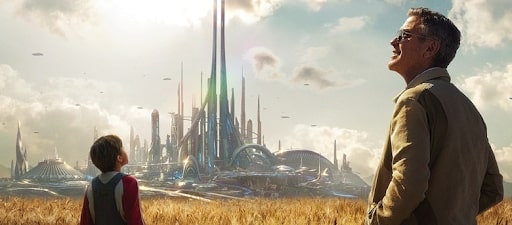
Space Mountain can also be seen in Disney’s 2015 live-action film Tomorrowland, as part of the futuristic cityscape.
The world of comics paid tribute to Space Mountain in 2014 when Disney Publishing Worldwide published a Space Mountain graphic novel. This book presented Space Mountain as a research station orbiting a black hole and harnessing its power to travel through time. At one point in the book, during the course of the time travel adventure, Space Mountain takes on the form of the Disneyland Paris Discoveryland version!
Space Mountain: An Interstellar Trip Through Disney History
Taking a ride on Space Mountain is truly like taking a trip through Disney Imagineering history. The innovation, technology, and creativity combine to make one of the most perfect theme park attractions of all time. Whether you keep your eyes peeled to spy the stars, or squeeze them shut and just listen to the music, you can’t help but absorb a bit of the cosmic coaster’s contagious energy.
—
Is Space Mountain one of your favorite Disney attractions? Reach out and let me know with an email (ji*******@*************nt.com) or with a message on social media: Instagram Facebook X
And If you enjoyed this article, please feel free to share it with friends.
Are you interested in blasting off to one of Disney’s Space Mountains? Reach out to Facts and Figment Vacation Planning. My travel planning services are absolutely FREE to you, and I can help you score the best, hardest-to-get deals to make your vacation more affordable. I can also take care of your dining reservations, attraction reservations, and any other special requests.
Sources referenced in writing this article include:
The Disney Mountains: Imagineering at Its Peak – Jason Surrell, 2007
Space Mountain Turns 50 at Magic Kingdom – Morgan Flaherty, WDW Magazine, January 14, 2025
The Secret Origin of Space Mountain – Wade Sampson (Jim Korkis), MousePlanet, August 8, 2007